

Walk into almost any athletic training room before practice and you'll see both.
One athlete is getting an ankle taped. Another is pulling on a brace they've worn all season.
Both are looking for additional ankle support. They just get there in different ways.
So is one better?
Not necessarily.
Athletic tape and ankle braces both have a place in sports. The better choice depends on why you need support, how often you need it, your footwear and what works best for you.
Here's how they compare.
Why do athletes tape or brace their ankles?
For many athletes, it starts with an ankle sprain.
Once you've injured an ankle, the risk of doing it again increases. Some athletes also develop recurring instability where the ankle feels more likely to roll or give way.
That's where external support can come in.
Both taping and bracing are intended to provide additional resistance against unwanted ankle movement. They may be used when returning from an injury or as an ongoing strategy to reduce the risk of another sprain.
Neither replaces proper rehabilitation.
Strength, balance and proprioception still matter. Think of taping or bracing as another layer of support when you're back on the field or court.
The case for ankle taping
There's a reason athletic trainers have been taping ankles for decades.
Tape is extremely customizable.
A trained athletic trainer can adjust the application based on the athlete, injury history and amount of support needed. Tape also adds relatively little bulk and can work well with tight-fitting athletic footwear.
For an athlete who has access to an athletic trainer, those are meaningful advantages.
There's also something reassuring about having the ankle freshly taped before competition. You know the application was done specifically for you and for that day's activity.
The tradeoff is that you have to do it again next time.
The case for an ankle brace
A brace takes the opposite approach.
Instead of rebuilding the support system with fresh tape before every practice or game, you reuse the same device.
That can make a brace convenient for athletes who need ankle support regularly.
It also means the structure of the brace doesn't depend on someone reproducing a taping technique each time.
Depending on the design, braces can range from flexible lace-up supports to more structured devices that physically resist unwanted ankle movement.
That variety means saying "I wear an ankle brace" doesn't tell you much about how much support you're actually getting.
What happens to tape during activity?
Athletic tape doesn't stay exactly the same from the moment it's applied until the end of a game.
Movement, sweat and repeated loading can affect the tension of the application over time.
That doesn't make tape ineffective. It's simply a characteristic of the material.
A reusable brace is designed to maintain its structural support throughout activity, although straps still need to be properly adjusted and the brace needs to fit correctly.
For an athlete looking for consistent support over a long practice or game, that's worth considering.
Which provides more support?
There's no universal answer because both taping techniques and ankle braces vary considerably.
A basic elastic ankle sleeve isn't automatically more supportive than a professionally taped ankle simply because it's called a brace.
Likewise, a structured ankle brace can provide considerably more mechanical control than a soft sleeve or basic tape application.
Instead of focusing only on tape vs. brace, ask what movement the solution actually controls.
If your concern is repeated lateral ankle sprains, for example, lateral stability is especially important.
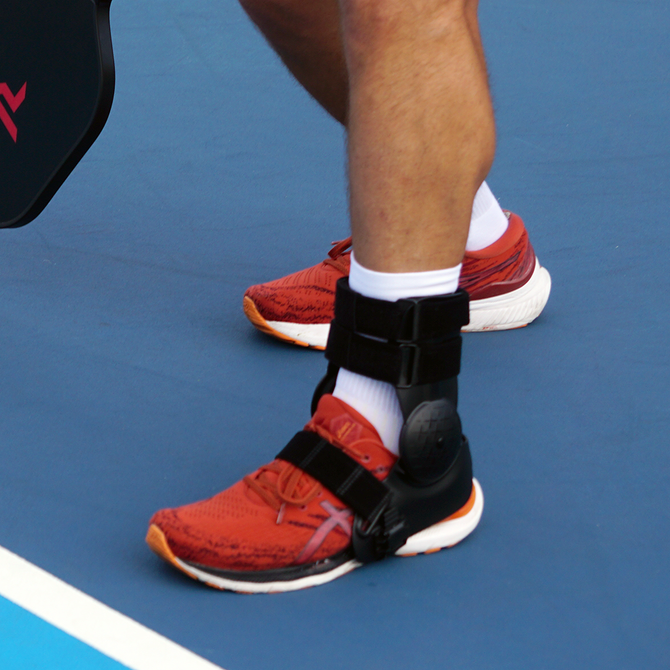
The AthleticX Brace uses a rigid external structure to control inversion, eversion and rotational movement while allowing plantarflexion and dorsiflexion.
In biomechanical testing, AthleticX Brace provided 2.4 times the lateral stability of a traditional lace-up ankle brace.
The point isn't that every athlete needs that much support. It's that the construction of the brace matters just as much as the category it falls into.
Which is better for cleats?
Tape has a natural advantage here: it's applied directly to the ankle, so it doesn't take up much additional space inside a cleat.
Many traditional ankle braces do.
That can make an inside-the-shoe brace challenging with snug football, soccer or other athletic cleats. Athletes may need to loosen the footwear to make room.
An external brace offers another approach.
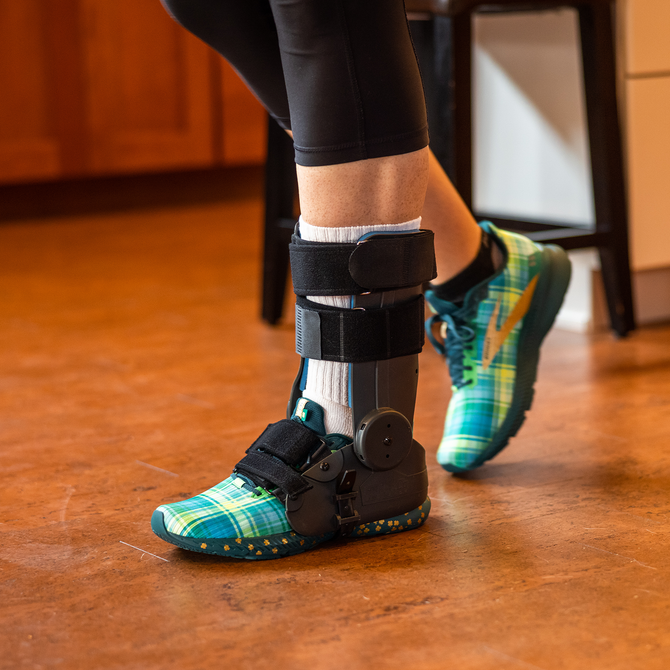
AthleticX Brace is worn around the outside of compatible cleats, so you don't have to squeeze the brace between your foot and footwear.
That can provide the stability of a structured brace while allowing the cleat to continue fitting directly around the foot.
Which is more convenient?
If you only need ankle support occasionally and have access to an athletic trainer, taping may be perfectly convenient.
If you're bracing every practice and every game for an entire season, the calculation changes.
Tape requires a new application each time. A reusable brace requires an initial fitting, but after that it can generally be put on and taken off as needed.
That can be particularly useful for athletes who don't always have an athletic trainer available.
There's no waiting for someone to tape you.
Your support is already in your bag.
What about cost?
For one application, tape is inexpensive.
Across an entire season, repeated taping adds up.
There's the tape itself, pre-wrap or other materials depending on the technique, and the time required for each application.
A reusable brace costs more upfront but can be used repeatedly.
Which is less expensive depends on how often you're using it and what type of brace you're comparing.
For an athlete who needs support a few times, tape may make perfect sense.
For someone getting taped five or six days a week over an entire season, a reusable brace becomes a different value proposition.
Can you tape and wear a brace?
More isn't automatically better.
Combining tape and a brace may add bulk or restrict movement without providing a meaningful additional benefit.
If you're returning from an injury or feel that one method isn't providing enough support, talk with your athletic trainer or healthcare provider rather than simply stacking more support onto the ankle.
The question should always be what the ankle needs, not how many things you can put around it.
What about athletes with previous ankle sprains?
This is where the conversation becomes especially important.
Previous ankle injury is a significant risk factor for another ankle sprain. Research has also shown that external ankle support can reduce ankle sprain incidence, particularly in athletes with a history of injury.
For those athletes, consistency matters.
Whether you choose taping or bracing, the support only helps when you actually use it.
That makes comfort, convenience and compatibility with your sport important parts of the decision.
So, should you tape or brace?
If you're looking for a simple winner, there isn't one.
Taping may make sense if:
-
You have regular access to an athletic trainer
-
You value a customized application
-
Your footwear has very little room
-
You only need support occasionally
A brace may make sense if:
-
You need support regularly
-
You want a reusable solution
-
You want consistent structural support
-
You need to put on your own support
-
You're managing recurring ankle instability
And an over-the-shoe brace may be worth considering if you want more structured support without taking up room inside your cleat or shoe.
The best option is the one you'll actually use
Tape and braces can both play a role in keeping athletes on the field.
The choice comes down to your ankle, your sport and your situation.
If you've had repeated ankle sprains or you're returning from an injury, involve your athletic trainer, physical therapist or healthcare provider. They can help determine how much support you need and whether taping or bracing is the better fit.
Because the goal isn't to win an argument about tape versus braces.
It's to give your ankle the support it needs so you can get back to playing.
Looking for reusable ankle support that doesn't have to fit inside your cleat? Explore the AthleticX Brace and its over-the-shoe design.


