
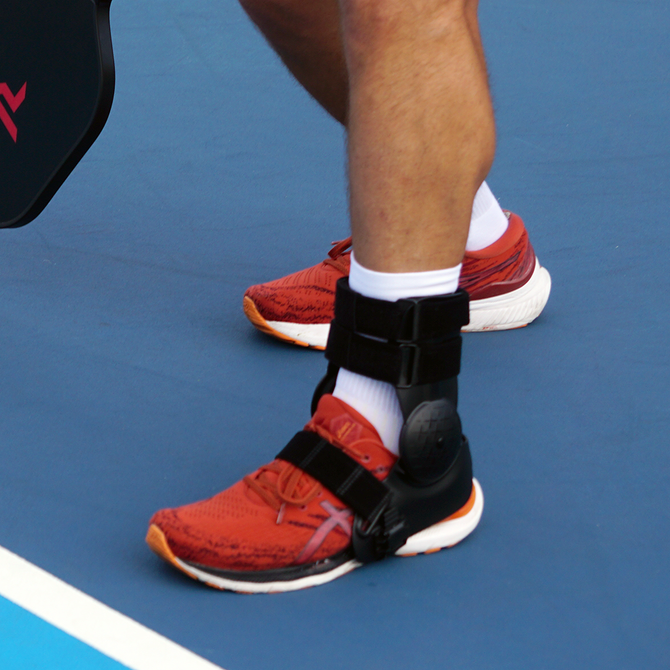

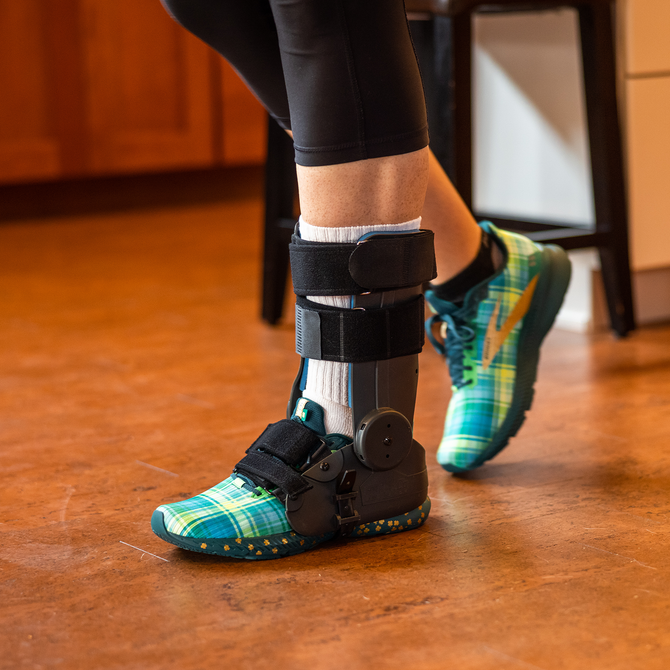
Most ankle braces have one thing in common: they go inside your shoe.
That seems logical. Your ankle is inside your shoe, so that's where the brace goes.
But it also creates a problem.
Your foot, sock and brace all have to compete for the same limited space. Add enough material to provide substantial support and suddenly your shoe may be too tight, uncomfortable or impossible to wear.
An over-the-shoe ankle brace flips that idea around.
Instead of squeezing the brace between your foot and footwear, the brace goes around the outside of the shoe. That creates more room to build stability into the brace while letting you continue wearing the footwear that's already supporting your foot.
It's a different approach to ankle bracing, and one that TayCo Brace was built around.
How does an over-the-shoe ankle brace work?
The shoe isn't simply something underneath the brace. It becomes part of the bracing system.
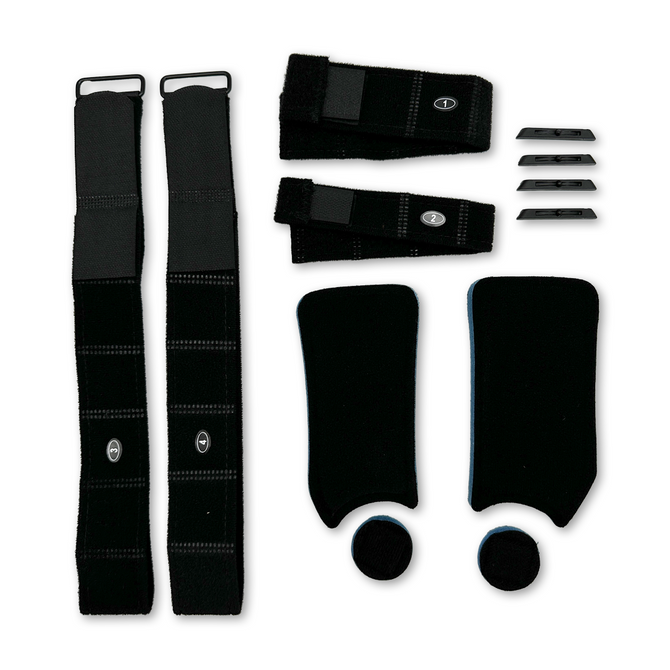
TayCo Brace products use a stirrup that runs underneath the shoe with uprights positioned along the sides of the ankle. Strapping secures the brace around the shoe and lower leg.
This external structure helps control unwanted ankle motion without filling the inside of your shoe with additional material.
Depending on the TayCo Brace product, the design can control inversion, eversion and rotational movement while either allowing or restricting plantarflexion and dorsiflexion.
That's an important distinction.
An ankle doesn't move in only one direction, and different situations call for controlling different movements.
Why put an ankle brace outside the shoe?
Space is one of the biggest advantages.
Traditional ankle braces have to fit between your foot and your shoe. The more structure and padding you add, the more space the brace takes up.
That can lead people to loosen their shoes, remove insoles, size up their footwear or simply tolerate a tighter fit.
Moving the brace outside the shoe removes much of that compromise.
It also allows the brace to use the structure of the shoe itself. Instead of trying to create an entire support system inside your footwear, the external brace works together with a supportive shoe, boot or cleat.
For many people, that means they can keep wearing footwear they're already comfortable in.
Is an over-the-shoe brace more supportive than a traditional ankle brace?
It depends on the braces being compared.
"Ankle brace" describes a huge range of products, from elastic sleeves to rigid orthoses. Where the brace is worn doesn't automatically determine how supportive it is.
The design does.
What an external design makes possible is more substantial structural support without having to fit that structure inside the shoe.
For example, biomechanics testing found the TayCo AthleticX Brace provided 2.4 times the lateral stability of a traditional lace-up ankle brace.
For injury recovery, research at Ball State University found that the TayCo Brace design provided 96% of the stability of a walking boot while allowing movement at the knee and hip that was closer to normal footwear.
Those are two different applications of the same basic idea: provide substantial external ankle stability while keeping the foot in its normal footwear.
Can you still move your ankle?
Yes, depending on the brace.
The AthleticX Brace is designed to control inversion, eversion and rotation while allowing plantarflexion and dorsiflexion. That means the ankle can move forward and backward while the brace provides support against unwanted side-to-side and rotational movement.
That's particularly important for walking, hiking and sports, where normal ankle movement is part of the activity.
The RecoverX Brace approaches movement differently because it's designed for injury recovery.
Its hinge can be locked at approximately 90 degrees, set to allow limited motion or opened to allow free plantarflexion and dorsiflexion.
In other words, an over-the-shoe design doesn't dictate how much movement you get.
The specific brace does.
What kinds of shoes work with an over-the-shoe ankle brace?
A supportive, closed-toe shoe generally provides the best foundation.
Depending on the brace and activity, that can include:
-
Athletic shoes
-
Walking shoes
-
Hiking shoes
-
Work boots
-
Football cleats
-
Other compatible athletic cleats
Fit still matters.
Very bulky soles, unusual heel shapes or certain shoe constructions may not work as well with an external brace. The brace also needs to be properly sized and adjusted for the footwear you're using.
The advantage is that you aren't trying to create extra room inside the shoe for the brace.
Can you wear one over a work boot?
In many cases, yes.
This can be especially useful for people whose jobs require specific footwear.
A traditional walking boot replaces your work shoe entirely, while many inside-the-shoe braces can make an already substantial work boot too tight.
An external brace can be worn over compatible closed-toe work footwear, allowing the shoe or boot to continue doing its job while the brace provides additional ankle support.
Your injury, workplace requirements and footwear all need to be considered when determining whether that's appropriate.
What about cleats?
This is another situation where putting the brace outside the footwear changes things.
Athletes often want ankle support without trying to squeeze a bulky brace inside an already snug cleat.
The AthleticX Brace can be worn over compatible cleats, allowing the cleat to fit the foot the way it was intended while the brace provides external ankle stability.
For athletes with a history of ankle sprains or instability, that can provide a different option from traditional lace-up bracing or taping.
Who might benefit from an over-the-shoe ankle brace?
The answer depends heavily on the specific product.
Someone recovering from an injury has different needs from someone hiking with chronic ankle instability. And both have different needs from a football player trying to reduce the risk of another ankle sprain.
Over-the-shoe bracing can be useful for people looking for:
-
Substantial ankle stability without putting a brace inside the shoe
-
Support while remaining in normal footwear
-
An alternative to traditional lace-up bracing
-
Ankle support with work boots
-
Ankle support with athletic cleats
-
Support for chronic ankle instability
-
A recovery option when a healthcare provider determines a walking boot is no longer necessary
The important part is matching the product to the need.
Which TayCo Brace product is designed for what?
The same external-bracing concept is used differently across TayCo Brace products.
AthleticX Brace
Designed for sports, everyday activity and ankle instability. It provides substantial lateral stability while allowing plantarflexion and dorsiflexion.
RecoverX Brace
Designed for injury recovery and everyday activities rather than sports. Its adjustable hinge allows the level of ankle movement to change throughout recovery.
CombatX Brace
Built on the same fundamental bracing approach as AthleticX Brace, with padding and strapping designed for more rugged environments.
TayCo Brace also offers provider-directed medical bracing for injuries and conditions requiring different levels of support.
A different way to think about ankle support
Ankle braces have traditionally been designed around the assumption that the brace belongs inside the shoe.
It doesn't have to.
Moving the brace outside the shoe creates room for more substantial structure, allows you to stay in your own footwear and lets the shoe itself become part of the support system.
More importantly, it gives people another option.
Because whether you're recovering from an injury, trying to stay active with an unstable ankle or looking for support on the field, the goal isn't simply to wear a brace.
It's to get the support you need without unnecessarily getting in the way of what you're trying to do.
Explore TayCo Brace products and find the over-the-shoe support designed for how you want to get back to it.


