

Most ankle braces start with the same basic assumption:
The brace goes inside your shoe.
That seems obvious because that's how ankle braces have traditionally been designed.
Compression sleeves wrap around the ankle. Lace-up braces add straps and support. Semi-rigid braces place more structure along the sides of the ankle.
Then your shoe goes over everything.
TayCo Brace products approach the problem from the opposite direction.
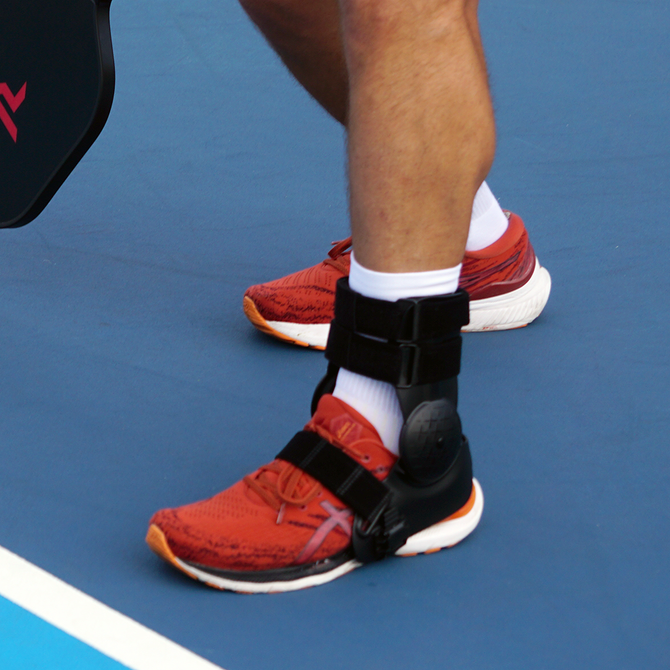
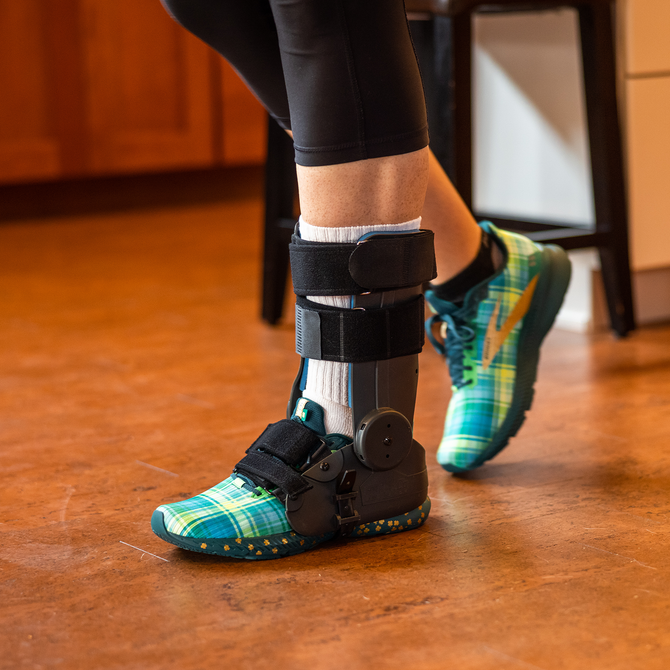
The brace goes over the shoe.
That might sound like a small design difference. It isn't.
Moving the structure outside the shoe changes how the brace fits, how it interacts with footwear and how substantial ankle stability can be provided while preserving movement.
Here's what that means in practice.
Traditional ankle braces work inside the shoe
There are many types of traditional ankle braces, and they don't all provide the same level of support.
A compression sleeve may primarily provide compression and a feeling of support.
A lace-up brace adds tension around the ankle and often uses figure-eight straps similar to athletic taping.
Semi-rigid braces add structural components along the ankle to provide greater mechanical control.
These designs can work very well.
But they all face the same physical limitation:
Your foot and the brace have to fit inside the same shoe.
That puts practical limits on how much material and structure can be placed around the ankle without affecting footwear fit.
TayCo Brace products move the structure outside
TayCo Brace products use an external design.
The brace sits around the outside of compatible footwear, with structural uprights alongside the ankle and a stirrup positioned beneath the shoe.
Instead of squeezing another layer between your foot and footwear, the brace uses the shoe as part of the system.
Your shoe continues fitting your foot.
The brace provides support around it.
That architecture is the foundation of what makes TayCo Brace products different.
Why does being outside the shoe matter?
Think about trying to add more structure to a traditional ankle brace.
Eventually, all of that material still has to fit inside the shoe.
You may need to loosen the laces. Remove or change the insole. Wear a larger shoe. Or simply tolerate more pressure around the foot and ankle.
Moving the structure outside changes that constraint.
It allows rigid components to provide mechanical stability without occupying the limited space between your foot and shoe.
That's particularly useful for people who need substantial support but still want to wear their normal compatible footwear.
Stability comes from structure, not tightness
Many traditional ankle braces create support by wrapping material tightly around the ankle.
TayCo Brace products rely more heavily on their external structure.
For example, the AthleticX Brace is designed to control inversion, eversion and rotational movement while allowing plantarflexion and dorsiflexion.
In biomechanical testing, AthleticX Brace provided 2.4 times the lateral stability of a traditional lace-up ankle brace.
That's an important distinction.
The brace doesn't simply feel tighter around the ankle.
Its structure is physically resisting the movement that can cause the ankle to roll.
For someone with chronic instability, repeated ankle sprains or a need for substantial lateral support, that difference can matter.
More structure doesn't mean the ankle has to be locked
When people see a rigid external brace, one of the natural assumptions is that it must restrict ankle movement.
But structure and immobilization aren't the same thing.
AthleticX Brace allows plantarflexion and dorsiflexion, the forward and backward ankle movements used during walking, running and jumping.
At the same time, its structure controls inversion, eversion and rotation.
In other words, the goal isn't to stop the ankle from moving.
It's to provide more control over the movements you don't want while preserving the ones you do.
Different TayCo Brace products solve different problems
The external architecture is shared across TayCo Brace products, but that doesn't mean every product does the same thing.
AthleticX Brace
AthleticX Brace is designed for sports, everyday activity and people who need additional ankle stability.
It allows plantarflexion and dorsiflexion while controlling inversion, eversion and rotation.
That makes it particularly relevant for chronic ankle instability, previous ankle sprains and active people who want substantial lateral support.
RecoverX Brace
RecoverX Brace is designed for injury recovery rather than sports.
Its adjustable hinge provides three levels of motion: locked, limited and free.
That allows the amount of ankle movement to change as recovery progresses.
Research comparing the external bracing approach with a CAM walking boot found that it provided 96% of the stability of the boot while allowing different movement through the lower extremity.
CombatX Brace
CombatX Brace uses the same fundamental external approach as AthleticX Brace but is built for more rugged environments.
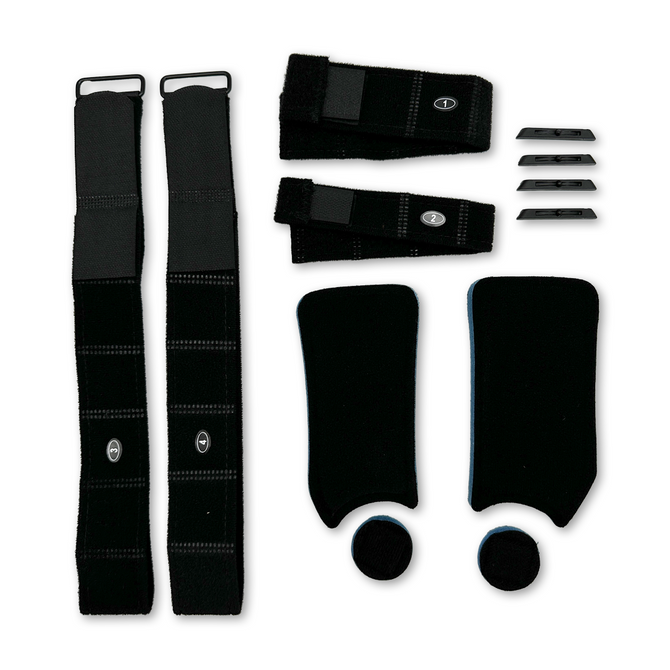
Its padding and strapping system are designed around demanding outdoor, work and tactical applications.
The underlying idea remains the same: provide substantial ankle stability around the outside of the footwear rather than inside it.
What about lace-up braces like ASO?
ASO and other lace-up ankle braces have been widely used in athletics and everyday ankle support for years.
They're relatively lightweight, familiar and appropriate for many people.
The biggest difference isn't the brand name.
It's the architecture.
A traditional lace-up brace relies primarily on fabric, laces and straps positioned inside the shoe.
AthleticX Brace uses an external structural frame.
That difference becomes particularly relevant when someone needs greater lateral stability or doesn't want additional material inside the shoe or cleat.
It doesn't mean every person wearing a lace-up brace should switch.
If a lace-up brace provides the support you need and works comfortably with your footwear, there's no reason to complicate the decision.
The external approach becomes more interesting when the limitations of traditional bracing start becoming limitations for you.
How does TayCo Brace compare with a walking boot?
This is a different comparison.
A walking boot isn't simply a more supportive ankle brace. It's designed to provide substantial protection and restrict movement during injury recovery.
For some injuries and stages of recovery, that's exactly what's needed.
RecoverX Brace provides another approach for situations where substantial stability is still important but the treatment or recovery plan permits a different amount of ankle movement.
In biomechanical research, the external bracing design demonstrated 96% of the stability of a CAM walking boot.
That doesn't mean RecoverX Brace should automatically replace a walking boot.
The appropriate level of protection depends on the injury and stage of recovery.
Instead, external bracing creates another option along the recovery continuum between substantial immobilization and less structured support.
What about shoes and cleats?
Footwear compatibility is one of the most visible differences between external and traditional bracing.
Traditional braces have to fit inside the footwear.
TayCo Brace products fit around compatible footwear.
That can make external bracing particularly useful with:
-
Athletic shoes
-
Football and other compatible cleats
-
Hiking footwear
-
Closed-toe work shoes and boots
-
Everyday sneakers
Shoe compatibility still matters. Not every shoe shape or construction works equally well with an external brace.
But when the footwear is compatible, you don't have to create extra room inside the shoe for the brace itself.
Is TayCo Brace right for everyone?
No.
And it shouldn't be.
Someone who wants mild compression probably doesn't need a structured external brace.
Someone who is comfortable and appropriately supported in a traditional lace-up brace may already have a solution that works.
Someone with a significant acute injury may need more protection or medical evaluation before choosing any brace.
External bracing becomes especially relevant when you need more stability, want to preserve appropriate ankle movement or don't want a brace occupying space inside your footwear.
The right solution depends on what you're trying to get back to.
It's not just another version of the same brace
That's ultimately the biggest difference.
TayCo Brace products aren't traditional ankle braces moved to the outside of the shoe.
The external architecture changes how the shoe, brace and ankle work together.
It creates room for more structure without putting that structure inside the footwear. It allows specific ankle movements to be controlled while others remain available. And it creates different options for everything from athletic stability to injury recovery.
Traditional braces still have an important place.
External bracing simply asks a different question:
What if the brace didn't have to fit inside your shoe at all?
That's the idea TayCo Brace was built around.
Explore TayCo Brace products to find the level of support designed for what you're trying to get back to.


