

If you've rolled the same ankle enough times, you probably know the feeling.
You're walking on uneven ground, coming down from a step or changing direction and suddenly the ankle starts to give way. Maybe you catch yourself. Maybe you don't.
After a while, the frustrating part isn't just another ankle sprain. It's not completely trusting the ankle underneath you.
Chronic ankle instability can develop after one or more ankle sprains, particularly when the ligaments and the systems responsible for controlling the ankle don't fully recover.
An ankle brace can provide additional stability, but there's a big difference between simply having something wrapped around your ankle and actually controlling the movement that keeps causing problems.
So what should you look for?
Start with the movement you're trying to control
Most ankle sprains occur when the ankle rolls inward, a movement called inversion.
If recurring ankle rolls are the problem, lateral stability should be one of the first things you consider in a brace.
Compression sleeves may feel supportive, but they provide relatively little mechanical resistance to an ankle that's beginning to roll. More structured braces are designed to physically limit that movement.
The tradeoff is usually between stability, movement, comfort and bulk.
The best balance depends on what you're trying to do.
Compression sleeves: light support
Compression sleeves are lightweight, simple and easy to wear.
They can provide compression and may help with swelling or the feeling of support around the ankle. What they generally don't provide is substantial mechanical control of inversion or eversion.
For someone primarily looking for compression or mild support, that may be enough.
For an ankle that repeatedly gives way, it may not be.
Lace-up braces: a familiar middle ground
Lace-up ankle braces are common in sports and everyday use.
They wrap tightly around the ankle and often include straps intended to mimic traditional athletic taping. They can provide more lateral support than a compression sleeve while remaining relatively flexible.
They also fit inside the shoe, which can create its own compromises.
A brace takes up space. That can mean loosening the shoe, changing the insole or finding footwear with enough room to accommodate both the foot and brace.
For many people, lace-up braces provide a reasonable balance of support and flexibility.
But someone with significant or recurring instability may want more structural control.
Semi-rigid and rigid braces: more structure
More structured ankle braces use plastic, composite or other rigid components to physically resist unwanted ankle movement.
Rather than relying primarily on fabric and tension, the brace itself helps prevent the ankle from moving too far in a problematic direction.
That additional stability can be useful for chronic ankle instability.
The challenge is finding that stability without unnecessarily restricting the movement you still want.
If you're hiking, walking, playing sports or simply moving through everyday life, your ankle still needs to plantarflex and dorsiflex.
That's where brace design becomes especially important.
An external brace takes a different approach
Most ankle braces have to fit between your foot and shoe.
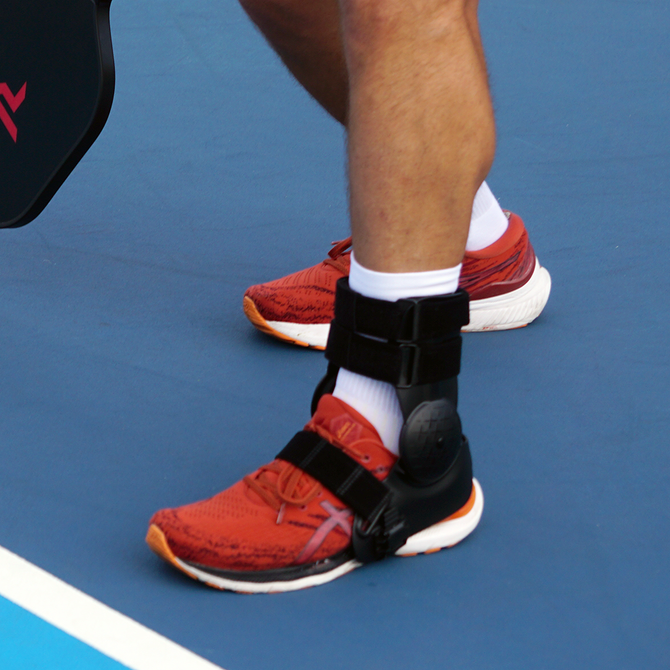
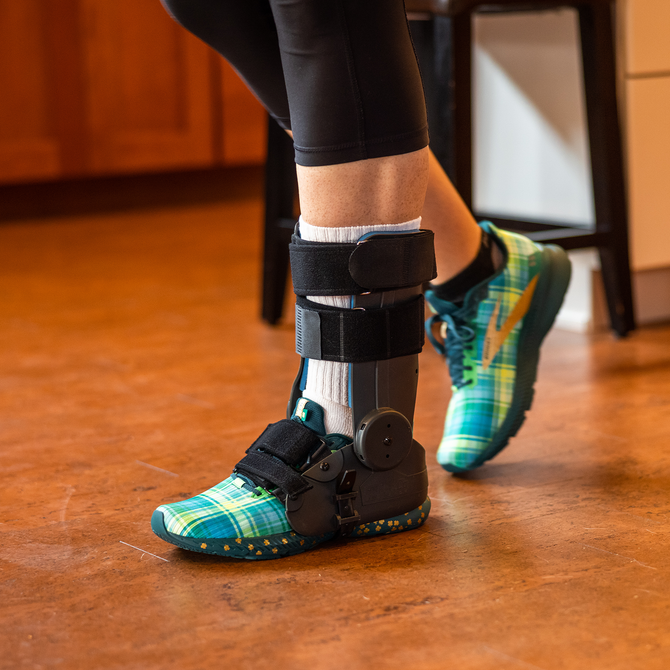
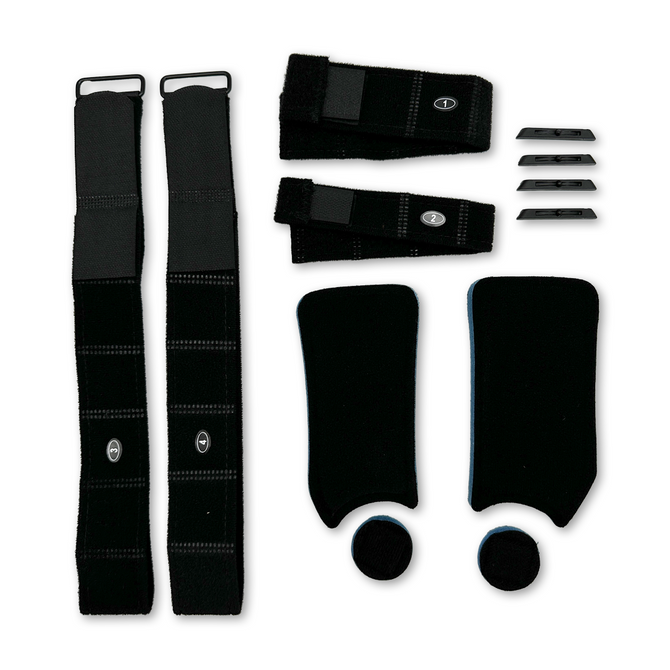
The AthleticX Brace is worn outside the shoe.
Its rigid external structure is designed to control inversion, eversion and rotational movement while still allowing plantarflexion and dorsiflexion.
That means the brace targets the side-to-side and rotational movement associated with instability without locking the ankle in place.
Because it's worn externally, the brace also doesn't take up space inside your shoe.
In biomechanical testing, the AthleticX Brace provided 2.4 times the lateral stability of a traditional lace-up ankle brace.
For someone whose primary problem is an ankle that repeatedly wants to roll, that difference in lateral stability is worth considering.
More stability doesn't have to mean less movement
This is one of the biggest misconceptions about ankle bracing.
It can seem like you have to choose between a brace that's flexible enough to move in or rigid enough to actually support you.
A well-designed brace can separate the movements you want from the movements you don't.
When you're walking, for example, plantarflexion and dorsiflexion help your body move forward over the foot.
When your ankle unexpectedly rolls inward, that's a very different movement.
A brace for chronic instability should ideally provide resistance where you need it without unnecessarily interfering everywhere else.
What if your ankle feels unstable during everyday activities?
Chronic ankle instability isn't only a sports problem.
An uneven sidewalk, a trail, yard work or simply stepping off a curb can be enough to make an unstable ankle give way.
If your goal is staying active rather than competing in a sport, many of the same brace characteristics still matter:
-
Lateral stability
-
Freedom to walk naturally
-
Comfort over longer periods
-
Compatibility with your normal footwear
-
Ease of putting it on and taking it off
The right brace is one you'll realistically use when you need it.
What about hiking?
Uneven terrain has a way of exposing an unstable ankle.
Rocks, roots, slopes and unpredictable footing constantly challenge the ankle in ways that a flat sidewalk doesn't.
For someone with chronic ankle instability, additional lateral support can provide more confidence on the trail.
Footwear still matters. A stable hiking shoe or boot provides the foundation, while an ankle brace can add another level of support.
An over-the-shoe brace such as AthleticX Brace can be worn with compatible hiking footwear without requiring additional space inside the shoe.
Can an ankle brace prevent another ankle sprain?
No ankle brace can guarantee you won't sprain your ankle.
But research has shown that ankle bracing can reduce ankle sprain risk, particularly among athletes with a history of previous sprains.
That's important because previous ankle injury is itself a risk factor for another injury.
Bracing also shouldn't be the only tool.
Strength, balance, proprioception and appropriate rehabilitation all matter when managing chronic ankle instability. A healthcare provider or physical therapist can help identify deficits that may be contributing to repeated injuries.
Think of a brace as additional protection, not a replacement for rebuilding the ankle.
Does wearing an ankle brace make your ankle weaker?
This concern comes up frequently, but wearing a brace doesn't mean you should stop strengthening the ankle.
The two approaches can work together.
A brace provides external support when you need it. Rehabilitation addresses strength, balance, range of motion and neuromuscular control.
If chronic instability is affecting your activity, the better strategy may be to improve what the ankle can do and provide additional protection during situations where it's most likely to give way.
When should recurring ankle instability be evaluated?
If your ankle repeatedly rolls, gives way or feels unstable, it's worth discussing with a healthcare professional.
Repeated sprains can damage more than the lateral ankle ligaments. Persistent instability may also be associated with cartilage injuries, tendon problems or other conditions that aren't solved simply by putting on a brace.
A brace can provide stability.
It can't tell you why the instability keeps happening.
Find the level of support that matches your ankle
There's no single "best ankle brace" for everyone with chronic ankle instability.
Someone looking for mild support may be perfectly happy with a lace-up brace.
Someone dealing with repeated ankle rolls during hiking, sports or everyday activity may benefit from substantially more lateral stability.
The important thing is knowing what you're asking the brace to do.
If the problem is an ankle that keeps rolling, look beyond whether a brace simply feels supportive.
Look at how it controls the movement that's actually causing the problem.
Looking for more lateral stability without putting a brace inside your shoe? Explore the AthleticX Brace and its over-the-shoe design.


