

After days or weeks in a walking boot, getting the green light to come out of it can feel like a big milestone.
Then you take your first few steps without it.
Your ankle may feel stiff. Your leg might feel weaker than you remember. Your normal shoe suddenly feels strangely unsupportive. And despite being excited to lose the boot, you may not completely trust the injured ankle yet.
That's because getting out of a walking boot and being fully recovered aren't necessarily the same thing.
For many injuries, there's a transition between the protection of a walking boot and getting completely back to normal.
Why does your ankle feel strange after a walking boot?
A walking boot is designed to limit movement and protect healing tissue. While that's useful during recovery, spending time with your ankle restricted can also change how the joint and surrounding muscles are being used.
When the boot comes off, you may notice:
-
Stiffness
-
Reduced range of motion
-
Weakness
-
Swelling
-
Changes in balance
-
An altered walking pattern
-
A general lack of confidence in the ankle
Some of that may simply be part of returning to normal movement.
Your body has also gotten used to walking with the boot. Returning to regular footwear means asking the ankle, knee and hip to move together normally again.
It can take some time for walking to feel natural.
Don't rush back into your oldest pair of shoes
After weeks in a bulky boot, almost any normal shoe can look appealing.
But this isn't necessarily the time to pull out the worn-out sneakers you've had for five years.
A supportive shoe can provide a better foundation as you transition back to normal walking. Look for a secure fit, stable platform and enough room to accommodate any remaining swelling or bracing your healthcare provider recommends.
The right shoe won't replace the support your ankle still needs, but it can be an important part of the transition.
You may still need ankle support
Coming out of a walking boot doesn't always mean going from maximum support to no support overnight.
Your healthcare provider may recommend an ankle brace during the next stage of recovery.
What that brace looks like depends on how much protection you still need.
A traditional lace-up or semi-rigid brace may be appropriate when less support is required.
For someone who needs more substantial stability, a hinged or over-the-shoe brace may provide another option.
The important distinction is that ankle braces aren't all providing the same level of support.
The right brace should match the injury and your stage of recovery.
There can be a middle ground between a boot and a traditional ankle brace
This is where recovery can sometimes get frustrating.
You may no longer need the full restriction of a walking boot, but a basic ankle brace may not feel like enough.
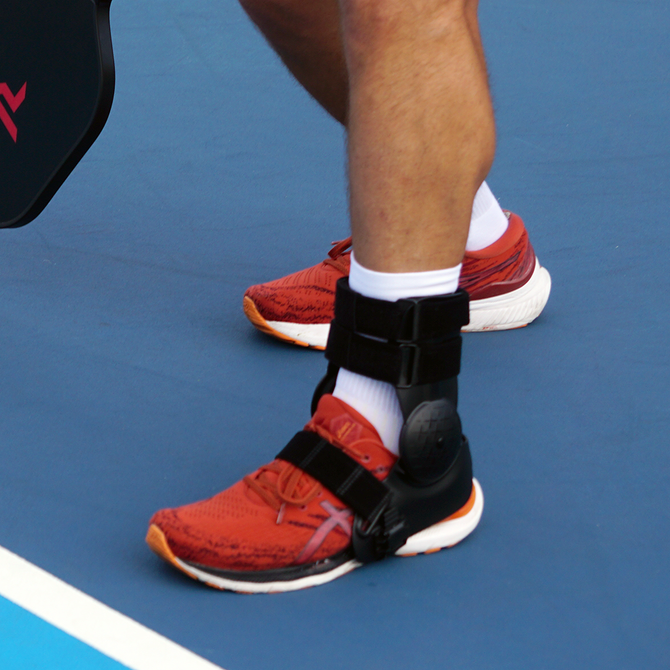
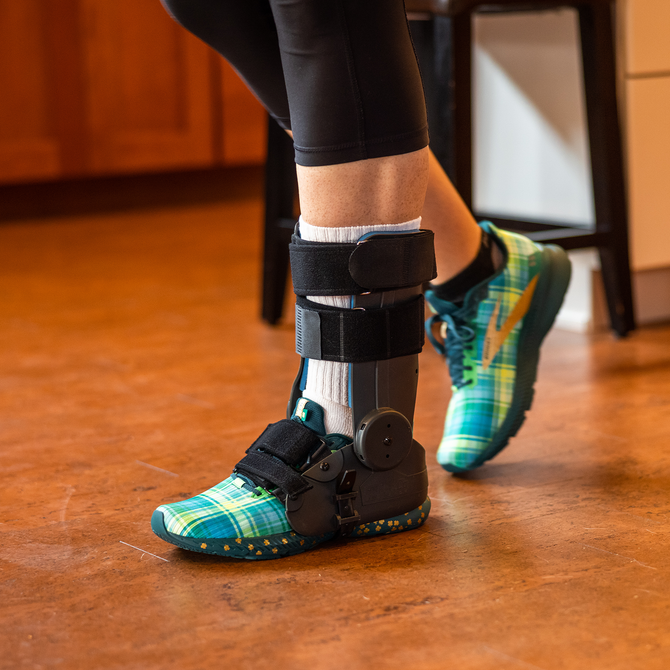
An over-the-shoe recovery brace is designed to occupy that middle ground.
The RecoverX Brace is worn outside your normal shoe and uses an adjustable hinge that can be configured in three ways:
-
Locked to substantially restrict ankle movement
-
Limited to introduce a controlled range of movement
-
Free to allow plantarflexion and dorsiflexion while continuing to control unwanted ankle movement
That means the brace can provide different levels of movement as needs change.
Research at Ball State University found that the TayCo Brace design provided 96% of the stability of a walking boot while allowing movement at the knee and hip that was closer to normal footwear.
For the right injury and stage of recovery, that can provide a way to maintain substantial support while getting back into your own shoe.
Movement usually comes back gradually
The first day out of a walking boot probably isn't the day to make up for everything you've missed.
Walking farther, standing longer and returning to exercise all increase the demands placed on the ankle.
Your healthcare provider or physical therapist may give you specific guidance for gradually increasing activity.
Pay attention to how your ankle responds.
Some stiffness or soreness may occur as you begin using the joint differently again. Significant increases in pain or swelling are worth discussing with your healthcare provider rather than simply pushing through.
Recovery isn't a test of how much discomfort you can tolerate.
Physical therapy may be part of what's next
Depending on your injury, physical therapy can help restore the things that immobilization doesn't.
That may include:
-
Range of motion
-
Strength
-
Balance
-
Proprioception
-
Gait
-
Confidence using the injured ankle
The goal isn't simply to make the ankle feel stronger.
It's to help the entire lower body get back to moving well together.
For someone returning to sports or a physically demanding job, rehabilitation may also become increasingly specific to those activities as recovery progresses.
Returning to work may require a different solution
Work doesn't always wait until recovery is complete.
If your job requires long periods on your feet, walking on uneven surfaces or wearing specific footwear, transitioning out of a walking boot can create its own set of challenges.
For example, someone required to wear closed-toe work boots may have difficulty returning while still in a CAM boot.
An over-the-shoe brace may allow compatible work footwear to remain in place while providing additional ankle support.
That doesn't automatically make it appropriate for every injury or workplace. Your healthcare provider and employer should help determine what is safe based on both your recovery and job requirements.
Getting back to sports is another transition
Returning to sports usually requires more from an ankle than returning to everyday walking.
Running, cutting, jumping and reacting to unpredictable movement place much greater demands on ankle stability.
That's also why the brace used during injury recovery may not be the brace you ultimately use for sports.
For example, RecoverX Brace is designed for recovery rather than athletic competition. Once an athlete is cleared to return to sport, a sport-specific brace such as the AthleticX Brace may be more appropriate when continued ankle support is recommended.
The progression might look different for every athlete.
The important part is not skipping steps simply because the ankle feels better.
How do you know when you're ready for less support?
There isn't one test or timeline that applies to everyone.
Your healthcare provider may consider your pain, swelling, strength, range of motion, stability, gait and healing progress. What you're trying to return to matters, too.
Walking around the house isn't the same as working a ten-hour shift on your feet.
And neither is the same as returning to a football field.
Instead of asking only:
"Can I stop wearing the boot?"
It can be more useful to ask:
"What support does my ankle need next?"
That shifts the conversation from simply removing a device to continuing your recovery.
The next stage should feel like progress
Getting out of a walking boot is worth celebrating.
It's a sign that you've moved forward.
But recovery doesn't have to be an abrupt jump from immobilization to nothing at all.
Support can change as your ankle changes. Movement can be introduced gradually. Strength and confidence can come back over time.
The goal isn't just to get out of the boot.
It's to get back to what you were doing before you needed it.
Still need support as you transition back into your own shoes? Explore the RecoverX Brace and learn how an adjustable over-the-shoe design can support the next stage of recovery.


