

Walking boots are used for a reason. When an ankle or foot needs protection after an injury or procedure, a walking boot can provide a high level of support and restrict movement while healing begins.
But that doesn't mean a walking boot is the only option throughout recovery.
Depending on the injury, where you are in the recovery process and your healthcare provider's recommendations, alternatives can range from supportive shoes and traditional ankle braces to more substantial ankle-foot orthoses (AFOs).
The right choice isn't simply about finding something more comfortable than a walking boot. It's about finding the appropriate level of protection while helping you get back to walking, working and doing the things that matter to you.
Why look for an alternative to a walking boot?
For many injuries, a walking boot may be exactly what you need, particularly during the earliest stages of recovery. The challenge is that immobilizing the ankle and changing the way you walk can affect more than just the injured area.
Walking boots can create a difference in leg length between your braced and unbraced sides. Research has associated this leg-length discrepancy and altered gait with secondary discomfort in areas such as the knee, hip and lower back.
There are practical challenges, too. A boot may make driving, stairs, work and everyday activities more difficult. It may also be incompatible with workplace footwear requirements.
That's why the better question often isn't, "How do I avoid a walking boot?"
It's:
"How much protection does my ankle need at this stage of recovery?"
The answer can change as you heal.
1. An over-the-shoe ankle brace
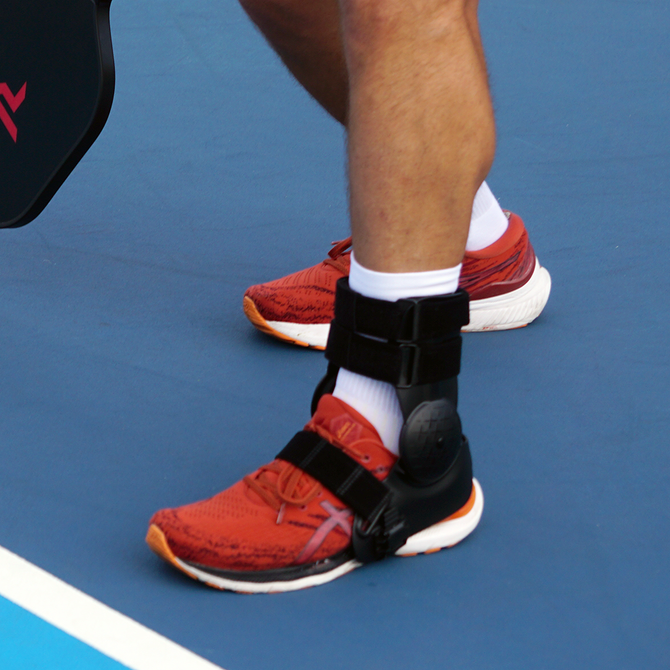
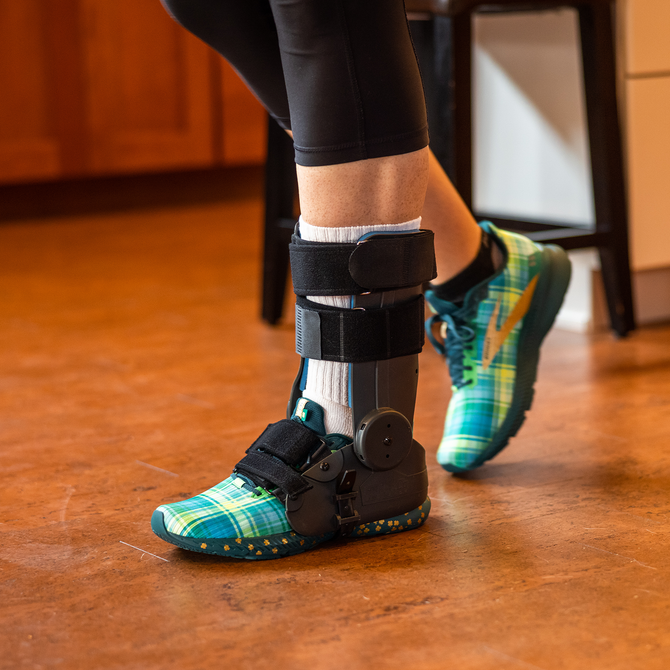
One alternative is an ankle brace designed to be worn outside your normal shoe rather than inside it.
This approach is different from most traditional ankle braces. Because the brace doesn't have to compete for space inside your shoe, it can provide substantial external support while allowing you to continue wearing supportive footwear.
TayCo Brace developed this approach specifically to combine ankle stability with more natural movement.
For injury recovery, the RecoverX Brace uses a hinged design with three settings:
-
Locked: Holds the ankle at approximately 90 degrees for maximum restriction.
-
Limited: Allows a controlled range of ankle movement.
-
Free: Allows plantarflexion and dorsiflexion while continuing to control unwanted ankle movement.
That adjustability means the level of restriction can change as recovery progresses when appropriate.
In biomechanics testing at Ball State University, the TayCo Brace design provided 96% of the stability of a walking boot while allowing movement at the knee and hip that was closer to normal footwear.
An over-the-shoe brace may be worth discussing with your healthcare provider when you still need substantial ankle support but complete immobilization in a walking boot is no longer necessary.
Explore the RecoverX Brace →
2. A traditional ankle brace
For less severe injuries or later stages of recovery, a traditional ankle brace may provide enough support.
This category includes:
-
Lace-up braces
-
Semi-rigid braces
-
Stirrup braces
-
Compression-style supports
-
Hinged braces
These braces generally fit inside the shoe and vary considerably in how much motion they control.
A compression sleeve, for example, may provide a feeling of support but offers much less mechanical stability than a rigid or semi-rigid brace. A lace-up brace may provide more lateral support but still allow considerably more ankle movement than a walking boot.
Traditional ankle braces can be particularly useful when the goal has shifted from protecting an acute injury to supporting the ankle during everyday activity or sports.
The important thing is to match the brace to the amount and type of support your injury actually requires.
3. An ankle-foot orthosis (AFO)
An AFO provides support to both the ankle and foot and can be either prefabricated or custom-made.
AFOs are used for a wide range of orthopedic and neurological conditions. Depending on the design, they can restrict motion, improve stability, assist with positioning or help compensate for muscle weakness.
Some fit inside the shoe. Others are designed to be worn externally.
For more complex injuries or longer-term conditions, a healthcare provider may recommend an AFO rather than a standard ankle brace.
TayCo Brace also offers medical bracing options designed for provider-directed care, including the Acute XAB Brace and Custom External AFO Brace.
4. Supportive footwear
Sometimes the appropriate next step isn't another medical device.
As healing progresses, a healthcare provider may recommend transitioning into a stable, supportive shoe. Features such as a firm heel counter, stable platform and appropriate fit can make a meaningful difference in how supported the ankle feels.
Footwear may also be combined with an ankle brace when additional stability is still needed.
The key is timing. A supportive shoe cannot provide the same level of protection as a walking boot or more substantial brace, so transitioning based solely on comfort can mean removing support before the injured tissue is ready.
5. Taping
Athletic tape can provide additional ankle support and is widely used in sports settings.
It has some advantages. Taping can be customized to the individual, works with most athletic footwear and doesn't require wearing a separate brace.
It also has limitations.
Proper application takes skill, support can decrease as the tape stretches during activity, and repeated taping requires new materials each time. For someone who needs ongoing support rather than short-term athletic use, a reusable brace may be more practical.
Walking boot vs. ankle brace: what's the difference?
The biggest difference is usually how much movement each device allows.
A walking boot is designed to substantially restrict ankle and foot motion. That's valuable when immobilization is part of the treatment plan.
An ankle brace typically allows more movement while controlling specific motions that could aggravate an injury or contribute to instability.
That distinction matters because recovery isn't always an on/off switch between "injured" and "healed."
There may be a period when you no longer need the restriction of a walking boot but aren't ready to go without support. For some people, an appropriate ankle brace can help fill that gap.
Can you wear an ankle brace instead of a walking boot?
Sometimes, but they aren't automatically interchangeable.
Whether an ankle brace is appropriate depends on the injury, its severity, healing progress, weight-bearing status and the specific brace being considered.
A mild ankle sprain and a healing fracture clearly don't require the same level of protection. Neither do the first few days after an injury and several weeks into recovery.
If a healthcare provider has instructed you to wear a walking boot, don't stop using it simply because another option looks more comfortable.
Instead, ask whether your current stage of recovery still requires full immobilization or whether a different form of support is appropriate.
What if the walking boot is causing knee, hip or back pain?
Don't ignore new pain simply because your original injury is improving.
Walking in a boot can alter gait mechanics, and the elevated sole can create a leg-length difference. Both can affect other joints as your body compensates.
Your healthcare provider may recommend addressing the height difference, adjusting the boot, modifying activity or transitioning to another form of support when medically appropriate.
If you're experiencing significant or worsening pain, contact your healthcare provider rather than changing your prescribed treatment on your own.
What about returning to work?
Work can make walking-boot recovery especially complicated.
Someone working at a desk has very different needs from someone who spends an entire shift standing, climbing or walking on uneven surfaces.
Footwear requirements can also matter. Some workplaces require closed-toe shoes, safety footwear or specific work boots that make a traditional walking boot impractical.
An over-the-shoe ankle brace can provide another option because certain designs can be worn with compatible work footwear. The appropriate solution still depends on your injury and your workplace requirements, so both should be considered before returning.
How do you know when you're ready to transition out of a walking boot?
There's no universal timeline.
Your healthcare provider may consider factors such as:
-
Type and severity of the injury
-
Pain and swelling
-
Healing of injured tissue or bone
-
Ability to bear weight
-
Ankle stability
-
Strength and range of motion
-
How you walk
-
Demands of work, sports and everyday activity
The next step may be normal footwear. It may be physical therapy plus a brace. Or it may be another period of protected movement.
The goal isn't to get out of the walking boot as quickly as possible. It's to progress to the right level of support at the right time.
Finding the right support for what's next
A walking boot can be an important part of recovery, but recovery doesn't necessarily have to begin and end in one.
As your needs change, the right support may change with them.
For some people, that's a supportive shoe. For others, it's a traditional ankle brace, AFO or an over-the-shoe solution that provides substantial stability while allowing a more natural walking experience.
If you're currently in a walking boot, start by talking with your healthcare provider about what your ankle needs now and what the next stage of recovery should look like.
Ready for the next stage of recovery? Explore the RecoverX Brace, an over-the-shoe ankle brace designed to provide substantial support while helping you get back into your own shoes.


