

Walking boots and ankle braces can both support an injured ankle, but they aren't interchangeable.
The biggest difference is the amount of movement they allow and the level of protection they're designed to provide.
A walking boot, often called a CAM boot, is generally used when the foot and ankle need significant protection and restricted movement. An ankle brace typically allows more movement while supporting or controlling specific motions.
But there's an important wrinkle: not all ankle braces provide the same level of support.
A compression sleeve, lace-up brace, semi-rigid brace and more substantial hinged brace can all be called "ankle braces," despite working very differently.
So if you're comparing a walking boot with an ankle brace, the better question is:
How much protection and movement does your ankle need right now?
What does a walking boot do?
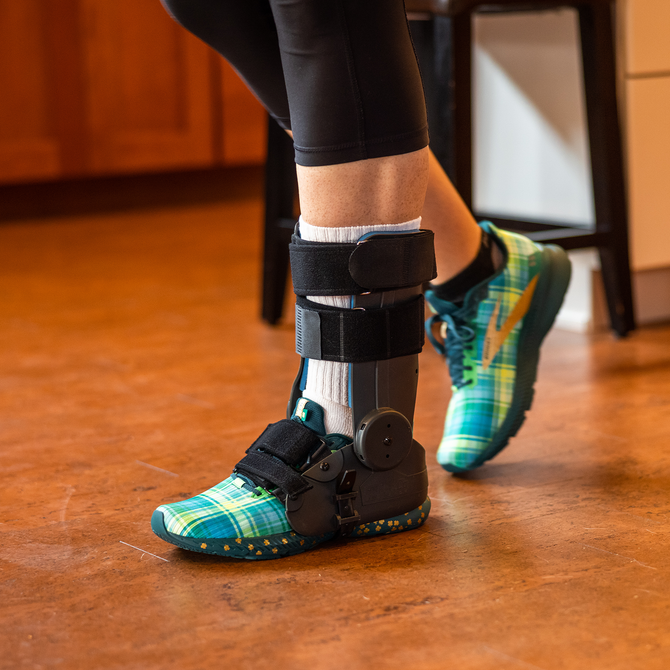
A walking boot surrounds the foot and lower leg with a rigid or semi-rigid structure. Its primary purpose is to protect the injured area by substantially limiting movement.
Depending on the injury, walking boots may be used for conditions such as ankle and foot fractures, severe sprains, tendon injuries and post-operative recovery.
Walking boots can provide a high degree of stability, which is exactly what some injuries require.
That stability comes with tradeoffs.
The thick sole of a walking boot can make the braced leg effectively longer than the other leg. The boot also changes normal ankle movement, which can alter the way the knee, hip and the rest of the body move while walking.
Those tradeoffs don't make walking boots bad. They simply matter when determining how much protection is still necessary as recovery progresses.
What does an ankle brace do?
An ankle brace supports the ankle while typically allowing more movement than a walking boot.
Exactly what it controls depends on the brace.
For example, some braces primarily provide compression. Lace-up braces can provide additional lateral support. Semi-rigid designs may more substantially control inversion and eversion. Hinged braces can combine substantial support with controlled ankle movement.
That's why comparing "a walking boot" with "an ankle brace" can be misleading without knowing which ankle brace you're talking about.
For someone with a mild ankle sprain, a traditional brace may provide appropriate support from the beginning.
For someone recovering from a more significant injury, a more substantial brace may become appropriate only after the ankle has progressed beyond the stage requiring greater immobilization.
How does an over-the-shoe ankle brace differ?
Most ankle braces are designed to fit inside a shoe.
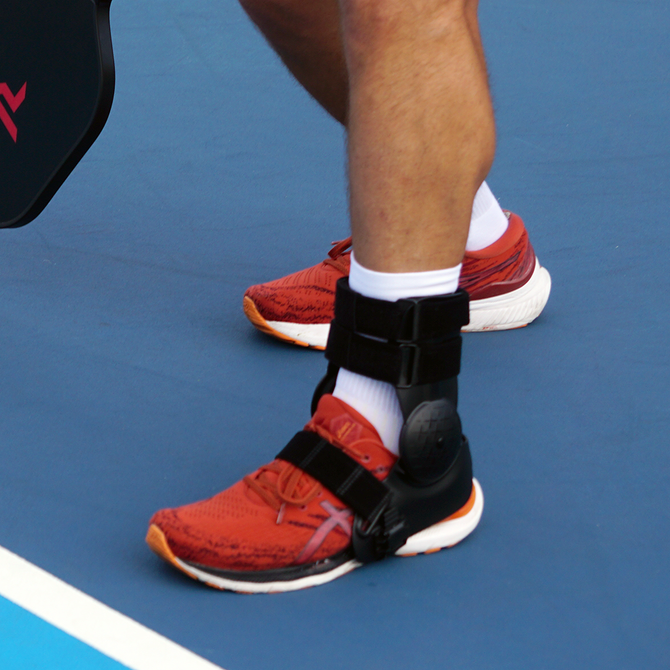
An over-the-shoe ankle brace takes a different approach. The shoe becomes part of the system, allowing the brace to provide external support without taking up space inside the shoe.
TayCo Brace products use this approach.
For recovery, the RecoverX Brace includes an adjustable hinge that can be configured in three ways:
-
Locked at approximately 90 degrees to substantially restrict ankle movement
-
Limited motion to allow a controlled range of movement
-
Free motion to allow plantarflexion and dorsiflexion while continuing to control unwanted ankle movement
This creates a different option between a traditional inside-the-shoe ankle brace and a walking boot for appropriate patients and stages of recovery.
How does stability compare?
This is where the specific brace matters.
Researchers at Ball State University compared the stability and movement provided by a TayCo Brace design with a walking boot and normal footwear.
The TayCo Brace provided 96% of the stability of the walking boot in the study.
But stability wasn't the only difference.
The researchers also observed differences farther up the body. Knee sagittal-plane movement was more constrained in the walking boot than in the TayCo Brace, while hip frontal-plane movement was also more constrained in the boot.
During stair descent, participants wearing the TayCo Brace demonstrated approximately 7 degrees more sagittal-plane movement than those wearing the walking boot.
In other words, the brace provided substantial ankle stability without affecting movement at the knee and hip in the same way as the walking boot.
That doesn't mean a TayCo Brace product should replace a walking boot for every injury. It means there can be meaningful differences between devices even when both provide substantial ankle stability.
Walking boot vs. ankle brace at a glance
| Walking Boot | Traditional Ankle Brace | Over-the-Shoe Recovery Brace | |
|---|---|---|---|
| Primary purpose | Protect and substantially restrict movement | Support the ankle while allowing movement | Provide substantial support with controlled movement |
| Ankle movement | Highly restricted | Varies by design | Adjustable depending on design/settings |
| Worn with your shoe | No | Usually inside | Yes, outside |
| Sole height difference | Typically yes | No | No additional sole |
| Fits with work footwear | Replaces footwear | Depends on shoe fit | Can work with compatible footwear |
| Best fit in recovery | When greater protection/immobilization is required | Often less severe injuries or later recovery | When substantial support is needed but a provider determines a boot is no longer necessary |
The right choice still depends on the injury and treatment plan.
Is an ankle brace more comfortable than a walking boot?
It can be, but comfort shouldn't be the deciding factor.
One of the biggest practical differences is footwear.
A walking boot replaces your normal shoe on the injured side. An inside-the-shoe ankle brace has to share limited space with your foot. An over-the-shoe brace allows you to wear compatible footwear underneath it.
For some people, returning to their own shoe can make walking and everyday activities feel more natural.
However, an injury that requires immobilization shouldn't receive less protection simply because another option feels better.
The goal is appropriate support first, with comfort and mobility considered within those requirements.
Can an ankle brace help avoid the uneven feeling of a walking boot?
One potential advantage of ankle braces is that they don't add a thick walking-boot sole underneath one foot.
Walking boots can create a temporary leg-length discrepancy because one foot is elevated higher than the other. That difference may contribute to changes in gait and discomfort elsewhere in the body.
Because an over-the-shoe ankle brace uses your existing shoe as its base, your footwear can remain more symmetrical from side to side.
This can be particularly meaningful as someone begins returning to more normal walking.
When should you switch from a walking boot to an ankle brace?
There isn't a standard number of days or weeks.
The appropriate timing depends on factors including:
-
The type of injury
-
Injury severity
-
Bone or tissue healing
-
Pain and swelling
-
Weight-bearing status
-
Ankle stability
-
Strength and range of motion
-
Your healthcare provider's treatment plan
For some injuries, an ankle brace may be appropriate relatively early. For others, a walking boot may be necessary for an extended period.
The transition should be based on healing and the level of protection you need, not simply how long you've been wearing the boot.
Can you wear an ankle brace instead of a walking boot?
Potentially, but only when the ankle brace provides an appropriate level of protection for the injury.
If your healthcare provider has placed you in a walking boot, don't replace it with an ankle brace on your own.
Instead, this is a useful conversation to have:
"Does my ankle still require the level of immobilization provided by this walking boot, or am I ready for a different level of support?"
If greater immobilization is still necessary, the walking boot may remain the right choice.
If you're ready to progress, your provider may recommend supportive footwear, an ankle brace, an AFO, physical therapy or a combination of approaches.
The goal isn't choosing a winner
A walking boot and an ankle brace serve different purposes.
Early in recovery, protecting an injury may matter more than mobility. Later, the balance can begin to shift toward controlled movement, more natural walking and returning to everyday activities.
That's why the best device today may not be the best device several weeks from now.
Recovery is a progression.
The goal is to provide enough support for where your ankle is now while helping you move toward where you want to be next.
If you're ready to discuss the next stage of recovery with your healthcare provider, learn more about the RecoverX Brace and its adjustable over-the-shoe design.


