

"Ankle brace" is an unusually broad term.
It can describe a $20 compression sleeve from a pharmacy, a lace-up sports brace, a walking boot, a custom-molded AFO or a device prescribed and fitted by a medical provider.
Those products aren't interchangeable.
They control different movements, provide different levels of stability and solve different problems.
For patients and providers trying to navigate those options, it helps to start with the purpose of the device rather than the name on the box.
Start with the clinical objective
Before comparing devices, ask what you're trying to accomplish.
Is the goal to:
-
Protect an acute injury?
-
Restrict ankle motion?
-
Control inversion and eversion?
-
Accommodate deformity?
-
Assist dorsiflexion?
-
Reduce load on injured structures?
-
Provide stability during weight bearing?
-
Transition a patient toward more normal movement?
-
Support an unstable ankle during everyday activity?
Different goals lead to very different devices.
And a patient's bracing needs may change throughout recovery.
CAM boots: substantial protection and immobilization
Controlled ankle motion boots, commonly called CAM boots or walking boots, are frequently used following ankle and foot injuries.
Their size and rigid construction can provide substantial protection while limiting ankle movement.
That can be exactly what's needed during certain stages of recovery.
But immobilization comes with tradeoffs.
A walking boot changes the way someone walks. Its elevated sole can create a limb-length difference between the booted and non-booted sides, and restricting ankle motion affects movement farther up the kinetic chain.
That doesn't make a walking boot a bad device.
It means the level of restriction should match the clinical objective.
As recovery progresses, the question may eventually shift from "How do we protect this?" to "How do we maintain appropriate support while restoring movement?"
That's where other bracing options become relevant.
Traditional ankle braces: support with greater mobility
Soft and semi-rigid ankle braces generally allow considerably more movement than a walking boot.
This category includes compression sleeves, lace-up braces, stirrup braces and other inside-the-shoe designs.
They can be useful for ankle sprains, instability and return to activity depending on the device and patient.
The tradeoff is generally less structural control than more restrictive devices.
Footwear can also become part of the equation because the brace and foot need to occupy the same space inside the shoe.
For patients who need greater mechanical stability or cannot comfortably accommodate a brace inside their footwear, other designs may be appropriate.
AFOs: controlling more than the ankle
An ankle-foot orthosis, or AFO, extends across the ankle and interacts with both the foot and lower leg.
That's an important distinction.
Depending on its design, an AFO can be used to control ankle position, provide mediolateral stability, influence gait, accommodate deformity or assist with conditions such as foot drop.
AFOs range from relatively simple prefabricated devices to highly customized orthoses.
The appropriate design depends heavily on diagnosis, biomechanics and the amount and direction of control required.
For some patients, custom fabrication may be necessary to accommodate anatomy or address complex biomechanical needs.
External bracing changes the relationship with the shoe
Most traditional ankle braces and AFOs are designed to work inside footwear.
External bracing takes a different approach.
Instead of placing the orthosis between the foot and shoe, the device uses the shoe itself as part of the bracing system.
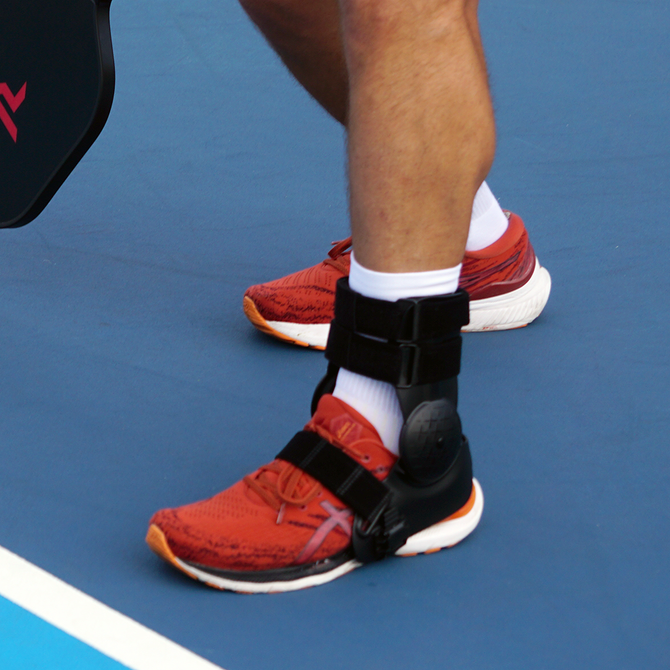
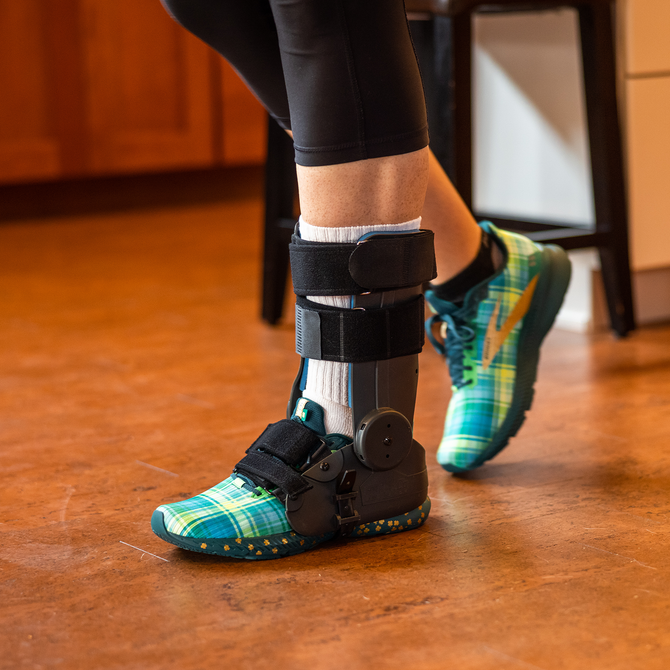
TayCo Brace products are worn around the outside of compatible footwear, with structural uprights connecting to a stirrup positioned beneath the shoe.
That distinction can have several implications.
The patient's shoe continues fitting the foot normally. The rigid structure doesn't occupy space inside the shoe. And depending on the device, substantial ankle control can be achieved while preserving selected movement.
For patients who struggle with traditional inside-the-shoe bracing, the architecture itself can create another option.
External doesn't mean one level of support
Just as all AFOs aren't the same, external braces can be designed for very different clinical objectives.
For example, the AthleticX Brace is designed to control inversion, eversion and rotational movement while allowing plantarflexion and dorsiflexion.
The RecoverX Brace adds an adjustable hinge with three settings:
Locked: holds the ankle at approximately 90 degrees.
Limited: permits a controlled range of motion.
Free: allows plantarflexion and dorsiflexion while maintaining structural support against unwanted motion.
That creates the ability to change the amount of permitted ankle movement as needs change.
Provider-directed external bracing options can provide still different levels of control based on the patient's diagnosis and treatment plan.
How does external bracing compare with a walking boot?
This is an area where biomechanics matter.
Research conducted at Ball State University compared an external TayCo Brace design with a CAM boot and normal shod walking.
The testing found that the external brace provided 96% of the stability of the CAM boot while producing different effects on movement farther up the kinetic chain.
The CAM boot constrained sagittal-plane knee motion compared with the external brace. Differences were also observed in hip motion, and during stair descent participants demonstrated approximately seven degrees more sagittal-plane movement while wearing the external brace than the boot.
That doesn't mean an external brace should replace every walking boot.
A patient who requires immobilization should receive the protection appropriate for the injury.
The findings instead raise a more useful clinical question:
When substantial ankle stability is needed, how much additional restriction is necessary?
The answer can change throughout recovery.
Recovery isn't necessarily one device from beginning to end
Orthopedic recovery is a progression.
Early after an injury or procedure, protection may be the overwhelming priority.
Later, weight bearing and controlled movement may become appropriate.
Eventually, the objective may shift toward restoring more normal gait, rebuilding strength and returning to everyday activity.
The device that makes sense during one stage doesn't automatically make sense during the next.
That creates an opportunity to think about bracing as a continuum rather than a binary choice between "in the boot" and "out of the boot."
In some cases, an adjustable or less restrictive brace can provide a middle stage between substantial immobilization and unsupported footwear.
Prefabricated vs. custom bracing
Another important distinction is whether the patient's needs can be addressed with a prefabricated device or require custom fabrication.
Prefabricated bracing can offer significant advantages when the patient's anatomy and clinical needs fit the design of the device.
Custom bracing becomes important when more individualized control, accommodation or fabrication is necessary.
Neither category is inherently better.
The goal is to use the appropriate level of intervention for the patient.
Coding doesn't tell you what a brace does
HCPCS codes are important for reimbursement and classification, but they shouldn't be mistaken for a complete description of device performance.
Different braces within a category can have very different designs, materials, joints and biomechanical characteristics.
TayCo Brace products span multiple applications and coding categories.
For example, AthleticX Brace is associated with L1906, while the provider-directed Acute XAB Brace is PDAC-verified for L1971. Custom External AFO Brace configurations may involve L1970, L2820 and L2755, depending on the device and circumstances.
Coding, coverage and documentation requirements should always be verified for the individual patient and payer.
The code is part of the clinical and administrative decision.
It isn't the entire decision.
Choosing the appropriate level of support
When evaluating ankle bracing options, consider more than the diagnosis alone.
The decision may include:
-
Required level of immobilization
-
Direction of instability
-
Permitted range of motion
-
Weight-bearing status
-
Footwear requirements
-
Patient anatomy
-
Gait
-
Activity demands
-
Ability to apply the device correctly
-
Expected progression through recovery
-
Patient adherence
A device can provide excellent mechanical support and still fail if the patient won't wear it.
That makes comfort, footwear compatibility and ease of use legitimate clinical considerations alongside stability.
Think in terms of the patient's next step
CAM boots, ankle braces and AFOs all have important roles.
The more useful question isn't which category is "best."
It's which device provides the appropriate amount and direction of control at this point in the patient's recovery or condition.
Sometimes that's substantial immobilization.
Sometimes it's a traditional ankle brace.
Sometimes it's a custom AFO.
And sometimes an external brace can provide the stability the patient needs while allowing something equally important: progression.
Learn more about TayCo Brace medical solutions and the clinical research behind external ankle bracing.


